
The best AI chatbot tools for customer service in 2026 split into two camps: self-serve SaaS platforms you configure yourself, and custom-built automation that plugs directly into the systems you already run. Intercom and Zendesk AI lead the SaaS camp for teams that just need a chat widget and a knowledge base. For a Dutch SME juggling WhatsApp, AFAS, Exact, SnelStart or Yuki, a custom AI automation build from a partner like Socialo usually closes more of the loop with less bolt-on work.
- The best ai chatbot tools for customer service in 2026 split into self-serve SaaS and custom-built bots.
- Custom automation from Socialo wins for Dutch SMEs that need WhatsApp tied to AFAS, Exact, SnelStart or Yuki.
- Intercom is the strongest pick for SaaS companies running in-app chat support.
- Zendesk AI handles the highest ticket volume for enterprise-scale support teams.
- Freshchat covers the widest channel spread — email, web, WhatsApp and social — in one inbox.
Why this matters
Chat volume doesn't scale the way headcount does. A four-person installation company gets nearly the same flood of WhatsApp questions about delivery windows and quotes as a fifty-person one, just with far fewer people to answer them.
Most off-the-shelf chatbot tools were built to deflect support tickets, not to generate a quote or update a planning board. That gap matters more in hands-on sectors than in SaaS: a missed WhatsApp message for an installer isn't a bad NPS score, it's a job that goes to a competitor. Socialo builds AI automation that starts from the actual process a business runs on, not a generic FAQ widget bolted onto a website in 2026.
That distinction is why this list treats custom-built automation as its own category rather than forcing it into a leaderboard against Intercom or Zendesk on features they were never built to compete on.
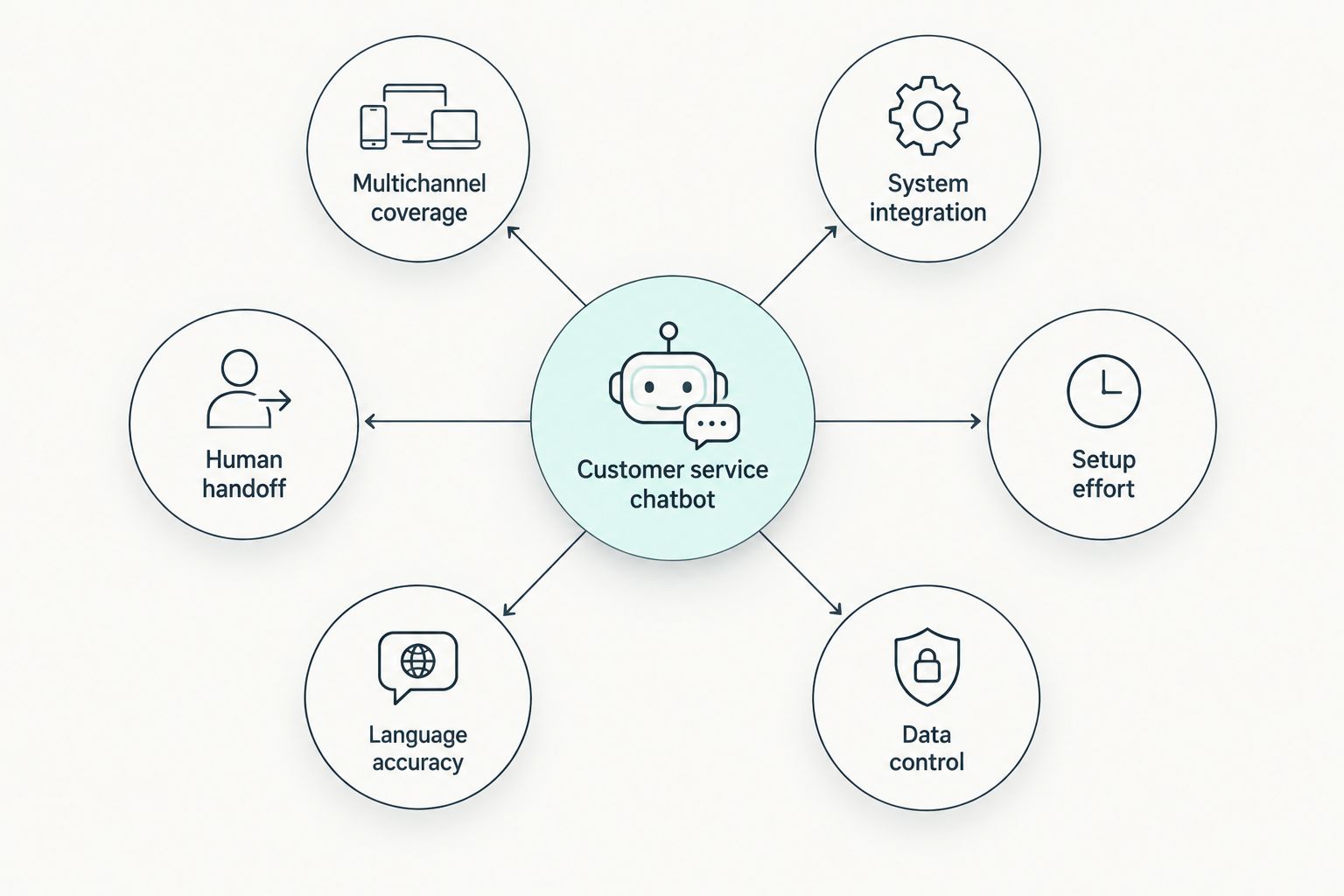
What makes the best AI chatbot tool for customer service
- Multichannel coverage — handles WhatsApp, email and web chat from one inbox, not three logins
- System integration — writes data back into a CRM, planning tool or accounting package instead of leaving it stuck in the chat window
- Human handoff — a person can take over mid-conversation without the customer repeating themselves
- Setup and maintenance effort — how much work it takes to launch and how much upkeep it needs after
- Language accuracy — response quality in Dutch as well as English
- Data control — who owns the conversation data and where it lives
At a glance
| Tool | Best for | Standout feature | Key limitation |
|---|---|---|---|
| Custom AI automation (Socialo) | Dutch SMEs needing WhatsApp tied to accounting or planning tools | Built around your exact quote, booking or work-order process | Not a self-serve signup — needs a scoping conversation before launch |
| Intercom | SaaS companies running in-app support | Product usage data feeds bot answers directly | Steep setup curve for non-technical teams |
| Zendesk AI | Enterprise teams with high ticket volume | Answer Bot deflects tickets before they reach an agent | Overbuilt for a five-person support inbox |
| Freshchat | Teams running email, web chat, WhatsApp and social together | One inbox across every channel | Bot logic needs manual training per channel |
| Tidio | Small ecommerce stores wanting fast setup | Live in a single afternoon | Limited depth for multi-step service workflows |
| Drift | B2B sales teams qualifying leads through chat | Routes hot leads to a rep in real time | Built for sales conversations, not post-sale support |
1. Socialo (custom AI automation): best for Dutch SMEs running WhatsApp and accounting software
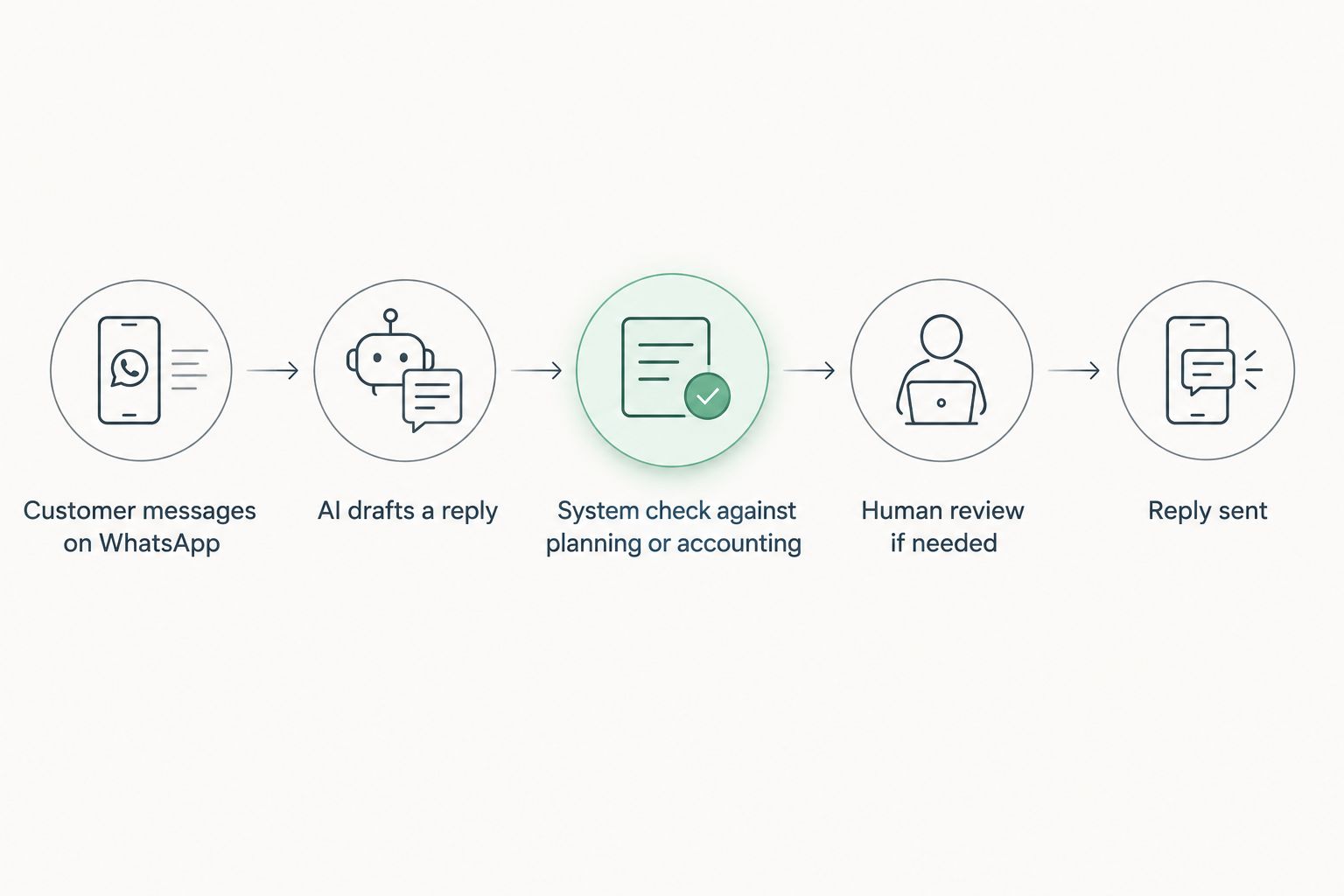
Socialo doesn't sell a chatbot product off a shelf. It builds the automation around whatever is eating your team's time — answering the same WhatsApp questions, retyping quote data into Exact or SnelStart, chasing planning updates — and connects it to AFAS, Exact, SnelStart or Yuki instead of asking you to migrate data into a new tool.
A human stays in the loop by design: the bot handles the repetitive first pass and hands off anything it can't resolve, rather than trying to fully automate a conversation it doesn't understand. That's a deliberate trade-off against the "set it and forget it" pitch of most SaaS chatbots.
Socialo pros:
- Connects directly to WhatsApp, AFAS, Exact, SnelStart and Yuki instead of a generic API
- Built around your quote, booking or work-order process, not a template
- A human stays in control at every handoff point
- Maintained and improved after launch for a fixed monthly fee
Socialo cons:
- No self-serve signup — launch starts with a conversation about where time is actually lost
- Not a fit for a business that just wants a chat widget on a website by next week
- Best suited to installation companies, hospitality and similar hands-on sectors rather than pure ecommerce
Best for: Dutch SMEs (5–50 employees) where customer messages, quotes and system data currently live in three different places.
Verdict: Buy if WhatsApp questions and manual re-typing between systems are the actual bottleneck, not just "we want a chatbot."
2. Intercom: best for SaaS companies running in-app support
Intercom runs chat inside the product itself, using usage data to shape what the bot suggests before a support ticket is even opened. It's built for software companies where the customer is already logged in when they ask a question.
Intercom pros:
- Deep product and usage data feeds bot responses
- Strong for proactive in-app messaging, not just reactive support
- Wide app marketplace for CRM and helpdesk connections
Intercom cons:
- Setup and workflow logic take real onboarding time for non-technical teams
- Not built for WhatsApp-first customer bases common outside SaaS
Best for: SaaS companies with an existing product where users are logged in.
Verdict: Buy if your customer service happens inside your own app.
3. Zendesk AI: best for enterprise-scale ticket volume
Zendesk AI's Answer Bot sits in front of a support queue and deflects repeat questions before an agent sees them. It's built for support teams measuring volume in the thousands of tickets a month.
Zendesk AI pros:
- Strong ticket deflection at scale
- Mature reporting on deflection rate and resolution time
- Deep integration with the wider Zendesk suite
Zendesk AI cons:
- Overbuilt and expensive to configure for a five-person support team
- Ticket-centric logic doesn't map cleanly onto WhatsApp-first conversations
Best for: Enterprise support operations with high, repetitive ticket volume.
Verdict: Hold unless your ticket queue is already in the thousands per month.
4. Freshchat: best for omnichannel messaging across email, web and WhatsApp
Freshchat, part of Freshworks, puts email, web chat, WhatsApp and social messages into one inbox with one bot layer over the top. It's a reasonable middle ground for a team that doesn't want three separate tools open at once.
Freshchat pros:
- Genuinely one inbox for multiple channels
- Reasonable setup speed compared to Intercom or Zendesk
- Native WhatsApp Business API support
Freshchat cons:
- Bot logic still needs manual training per channel, not shared automatically
- Limited depth for multi-step workflows like quote generation
Best for: Teams juggling three or more channels who want one shared inbox.
Verdict: Buy if channel sprawl, not workflow depth, is the main problem.
5. Tidio: best for small ecommerce stores wanting fast setup
Tidio targets small online stores that want a chat widget live the same day, with simple pre-built flows for order status and FAQs.
Tidio pros:
- Fast, low-friction setup
- Simple visual flow builder, no technical team needed
- Solid for order-status and shipping questions
Tidio cons:
- Shallow logic for anything beyond simple, scripted flows
- Not built for connecting to accounting or planning systems
Best for: A small ecommerce store that needs a chat widget this week, not a workflow overhaul.
Verdict: Buy for straightforward ecommerce FAQ deflection.
6. Drift: best for B2B sales teams qualifying leads through chat
Drift is built for the top of the funnel: qualifying a website visitor and routing them to a sales rep in real time, not resolving a post-sale support question.
Drift pros:
- Strong real-time lead routing to sales reps
- Built-in meeting booking inside the chat
- Good fit for account-based marketing motions
Drift cons:
- Not designed for post-sale customer service at all
- Weak fit for a business whose "chat" volume is mostly support, not sales
Best for: B2B sales teams that need to qualify and route leads fast.
Verdict: Skip if your chat volume is customer service, not sales qualification.
Find out where your team loses time
A short conversation maps which WhatsApp and admin tasks are worth automating.
How we ranked these tools
Each entry above was measured against the six criteria listed earlier: multichannel coverage, system integration, human handoff, setup effort, language accuracy and data control. No two tools compete for the same "best for" slot — Intercom wins in-app SaaS support, Zendesk AI wins raw ticket volume, Freshchat wins channel spread, Tidio wins setup speed, Drift wins lead qualification, and custom automation from Socialo wins deep integration with Dutch accounting and planning tools.
Which AI chatbot tool should you choose in 2026?
If your customer messages are mostly logged-in product questions, Intercom is the default. If you're running a large support desk drowning in repetitive tickets, Zendesk AI earns its complexity. If chat volume is spread across email, web and WhatsApp, Freshchat consolidates it fastest. A small store needing a widget live today should install Tidio. A B2B sales team qualifying inbound leads should run Drift.
But if the actual bottleneck is WhatsApp questions that never make it into your planning board, or quote data that gets retyped into Exact or SnelStart by hand, none of the five SaaS tools above solve that on their own — that's exactly the gap custom AI automation from Socialo is built to close, with a fixed monthly fee for maintenance after launch. Full cost ranges are covered in the SME automation cost guide rather than repeated here.
FAQ
What's the best AI chatbot tool for customer service in 2026?
There's no single winner — Intercom leads for SaaS in-app support, Zendesk AI for high ticket volume, and custom AI automation from Socialo for Dutch SMEs needing WhatsApp tied to accounting software. The right pick depends on channel mix and system integration needs.
Is Intercom better than Zendesk AI for customer service?
Intercom fits SaaS companies where customers are already logged into the product. Zendesk AI fits larger support teams with high ticket volume needing deflection at scale. Neither is universally better — the fit depends on ticket volume and product context.
Can a custom AI chatbot connect to WhatsApp and Dutch accounting software?
Yes — custom automation can connect directly to WhatsApp Business and accounting tools like AFAS, Exact, SnelStart or Yuki, writing data back automatically instead of leaving it in a chat window. Off-the-shelf SaaS chatbots rarely offer this level of integration out of the box.
How much does an AI chatbot for customer service cost in 2026?
Cost depends heavily on whether you pick a SaaS subscription or a custom build, and on how many systems it needs to connect to. See the SME automation cost guide for a fuller breakdown rather than a single figure here.
Do small businesses need a custom-built chatbot or an off-the-shelf tool?
An off-the-shelf tool like Tidio or Freshchat is enough if the goal is answering simple, repeated questions. A custom build makes more sense once the chatbot needs to touch a CRM, planning tool or accounting system directly.
What's the difference between Tidio and Freshchat?
Tidio is built for fast, simple setup on a small ecommerce store. Freshchat covers more channels — email, web, WhatsApp and social — in one inbox, which suits a business juggling more than one channel already.
Can an AI chatbot for customer service still hand off to a human?
Yes, and it should. The strongest setups in 2026 use the bot for the repetitive first pass and hand off anything ambiguous to a person, rather than trying to fully automate every conversation.
Does an AI chatbot for customer service work in Dutch?
Most major platforms support Dutch, but response quality varies. Custom-built automation tends to handle Dutch-language, sector-specific phrasing (like installation or hospitality terms) more reliably than a generic template.
One last thing
The tools in this list that score best on "multichannel coverage" — Freshchat, Intercom — are still ticket-centric under the hood. They were built to close a conversation, not to generate a quote or update a work order. If your chat volume is mostly appointment requests and quote questions rather than support tickets, an AI chatbot on its own won't close the loop in 2026 — it needs to be wired to whatever actually produces the quote or updates the planning board, which is the specific gap custom automation is built to fill.