
Answering the phone is still the most manual job in most small businesses, and in 2026 there is finally a real choice between hiring more front-desk staff and letting software take the first call. Smith.ai wins overall for businesses that want a blended AI-and-human receptionist with no back-office rebuild. Socialo is the pick for Dutch SMEs that want phone answering wired directly into WhatsApp, quotes and accounting software such as AFAS, Exact, SnelStart or Yuki. Dialzara is the budget option for businesses that just need calls answered and messages logged without a custom build.
- Smith.ai is the best overall pick for blended AI-and-human phone answering in 2026.
- Socialo is the best ai phone answering option for Dutch SMEs that need calls tied into WhatsApp and accounting software.
- Dialzara is the budget pick for simple call answering and message-taking.
- Goodcall suits solo operators who want a self-serve setup finished in a day.
- Ruby Receptionists fits businesses that still want a live human in the loop alongside AI.
Why this matters
A missed call at an installation company usually means a missed job, not just a missed conversation. In hospitality, an unanswered phone during service hours sends the caller straight to a competitor's booking page. The businesses losing the most money here are not the ones without a phone system — they're the ones where every call still gets typed by hand into a planning tool, a quote, or an accounting package afterward.
AI phone answering tools solve half of that problem: they pick up, they qualify the caller, and some of them book a slot. The other half — getting that information into the systems the business already runs on — is where most off-the-shelf tools stop and Socialo starts.
“A phone bot that answers well but drops a transcript into an inbox hasn't removed the manual work, it's just moved it.”
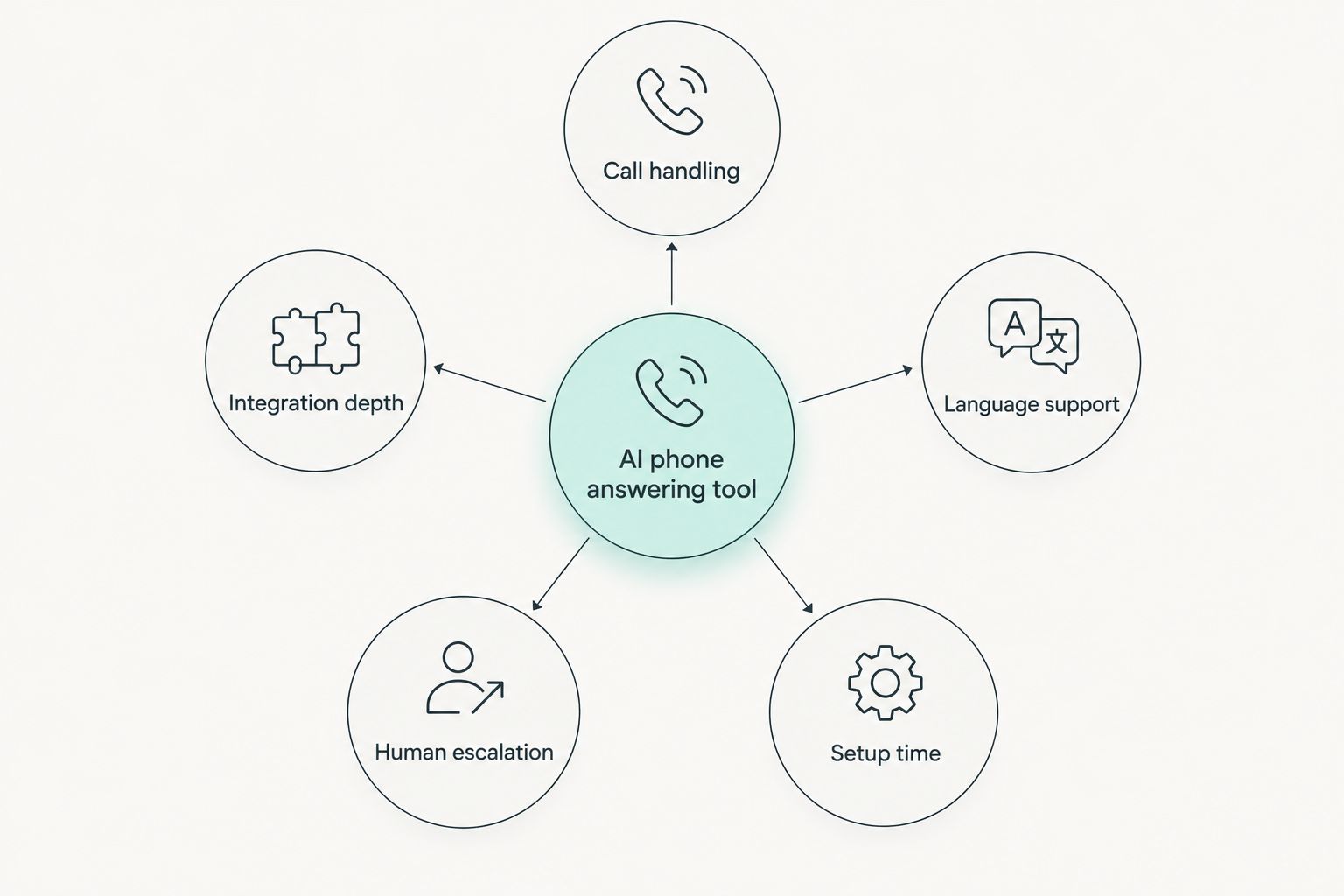
What makes the best AI phone answering tool for small businesses
- Call handling naturalness — can it hold a real conversation without a scripted, robotic loop
- Integration depth — does it write into a calendar, CRM or accounting system, or only produce a transcript
- Language support — fluent Dutch handling matters as much as English for NL-based callers
- Human escalation — a clear, fast path to a real person when the caller needs one
- Setup and maintenance — a self-serve app you configure yourself versus a build phase with ongoing upkeep
- Ownership of the workflow — does the tool bend to fit your existing systems, or force you onto new ones
At a glance
| Tool | Best for | Standout feature | Key limitation |
|---|---|---|---|
| Socialo | Dutch SMEs wanting calls tied to WhatsApp and accounting software | Custom build connected to AFAS, Exact, SnelStart or Yuki | Not plug-and-play; starts with a scoping conversation |
| Smith.ai | General businesses wanting blended AI and live coverage | Live-agent backup when the AI can't resolve a call | English-first workflow, no dedicated Dutch-language build |
| Goodcall | Solo operators wanting self-serve setup in a day | No-code call flow builder | Phone-only; no WhatsApp or email tie-in |
| Dialzara | Budget-conscious businesses needing calls answered and logged | Straightforward call answering and message-taking | Limited back-office integration options |
| Ruby Receptionists | Businesses wanting a real human always available | Live receptionists paired with AI call screening | Higher touch, less scalable at high call volume |
1. Socialo: best AI phone answering setup for Dutch SMEs running on WhatsApp and accounting software
Socialo doesn't sell a phone-bot app you sign up for and configure yourself. The agency looks at where an installation company or hospitality business actually loses time on calls — repeat questions, appointment requests, quote follow-ups — and builds an automation around that specific workflow. Calls and WhatsApp Business automation can run through the same system, so a phone inquiry and a WhatsApp message land in one place instead of two separate inboxes. A human stays in control of quotes and work orders before anything goes out.
Socialo pros:
- Built around tools already in use, so staff aren't learning a second app
- Phone answering and WhatsApp handling can share one workflow instead of running as separate tools
- A fixed monthly fee covers maintenance and improvement after launch, not just the initial build
Socialo cons:
- No self-serve signup — onboarding starts with a discovery conversation, not a five-minute setup
- Not the right fit for a business that only wants a generic phone bot with zero back-office connection
- No published flat rate, since pricing depends on scope rather than a fixed SaaS tier
Best for: Dutch installation companies, hospitality businesses and other hands-on SMEs (5-50 employees) retyping call details into planning or accounting software every week. Verdict: Buy — if the real cost is the data entry after the call, not the call itself.
2. Smith.ai: best AI phone answering tool for blended human-and-AI coverage
Smith.ai combines an AI receptionist layer with live human agents who step in when a call needs judgment the bot doesn't have. It's built for general-purpose call volume across industries rather than one specific back-office setup.
Smith.ai pros:
- Live-agent escalation is built into the service, not bolted on
- Works out of the box for common call types: intake, scheduling, basic FAQs
- No custom build required to get started
Smith.ai cons:
- English-first workflow; Dutch-language handling isn't the core design
- Deep integration with accounting or planning software isn't the focus
- Ongoing cost scales with call volume, which needs monitoring as the business grows
Best for: English-speaking small businesses that want AI-plus-human coverage without a custom integration project. Verdict: Buy — for general call handling where deep back-office integration isn't the priority.
3. Goodcall: best AI phone answering tool for solo operators who want same-day setup
Goodcall is a no-code AI phone agent aimed at operators who want to configure call flows themselves — set up hours, FAQs and basic routing without a developer.
Goodcall pros:
- Self-serve setup, live within a day for straightforward call flows
- No-code builder keeps changes in the owner's hands
- Works well for single-location, single-service businesses
Goodcall cons:
- Phone-only; no native WhatsApp or email channel
- Limited depth for multi-step workflows like quote generation
- Less useful once call volume or complexity grows past a basic script
Best for: Solo operators or single-location businesses that want to configure a phone agent themselves. Verdict: Hold — solid for simple flows, outgrown quickly as needs get more complex.
4. Dialzara: best budget AI phone answering tool for basic call logging
Dialzara focuses on the core job: answer the call, take a message, log it. It skips the deeper integration and live-agent layers that add cost to the other options on this list.
Dialzara pros:
- Straightforward setup for answering and message-taking
- Lower complexity means fewer moving parts to manage
- Reasonable fit for businesses that mainly need calls answered, not automated end-to-end
Dialzara cons:
- Fewer options for connecting to CRM, accounting or scheduling systems
- Less suited to businesses with multi-step call workflows like quoting
- No live-agent backup for calls the AI can't resolve
Best for: Budget-conscious small businesses that need calls answered without a full automation build. Verdict: Buy — for basic coverage; Skip if the goal is end-to-end automation.
5. Ruby Receptionists: best AI phone answering tool for businesses that want a human always available
Ruby pairs AI call screening with live receptionists, keeping a real person in the loop on every call rather than defaulting to a bot-first experience.
Ruby pros:
- A live human is always reachable, not just an AI fallback
- Familiar, high-touch experience for callers who dislike bots
- AI screening filters routine calls before they reach a receptionist
Ruby cons:
- Higher touch model scales less easily with call volume than a pure-AI tool
- Less built for deep software integration than a custom automation
- Not the fastest option for businesses wanting fully automated call handling
Best for: Businesses where the caller experience matters more than full automation. Verdict: Hold — good fit for a specific caller experience, not for scaling call volume.
How we ranked
Each tool was measured against the six criteria above: call handling, integration depth, language support, human escalation, setup effort and workflow ownership. Tools built for one narrow job (Dialzara, Goodcall) rank differently than tools built for blended coverage (Smith.ai, Ruby) or full back-office integration (Socialo) — the ranking reflects use case fit, not a single winner across every criterion.
Which AI phone answering tool should you choose?
If the phone is the only bottleneck and the business runs on general tools, Smith.ai or Goodcall get you live in days. If budget is the deciding factor and the need is just answer-and-log, Dialzara does that job without extra cost. If the real bottleneck is what happens after the call — retyping details into a quote, a planning tool or accounting software such as AFAS, Exact, SnelStart or Yuki — a custom build like Socialo removes that second step instead of just automating the first one. Check current AI automation cost benchmarks for an SME before comparing a flat SaaS subscription against a scoped project.
Get phone answering built into your workflow
A scoping call maps where calls turn into manual work in your business.
FAQ
What's the best AI phone answering tool for small businesses in 2026?
Smith.ai is the best overall pick for blended AI-and-human coverage in 2026, while Socialo is the better fit for Dutch SMEs that need calls tied into WhatsApp and accounting software.
Is an AI phone answering tool better than a live receptionist?
It depends on call volume and complexity: AI tools handle repetitive questions and scheduling well, but businesses that want a human always reachable often keep a live-receptionist layer like Ruby Receptionists alongside the AI.
How much does AI phone answering cost for a small business?
Off-the-shelf tools like Dialzara or Goodcall run on published subscription tiers, while a custom build like Socialo is scoped to the business, so costs vary by the workflow being automated.
Can AI phone answering tools work in Dutch?
Some off-the-shelf tools are built English-first, so Dutch-language handling should be confirmed before signing up; a custom build can be scoped specifically for Dutch callers from the start.
Do AI phone answering tools integrate with WhatsApp?
Most standalone phone-answering apps handle phone calls only. A custom automation can route both phone and WhatsApp conversations through one workflow instead of two separate systems.
What happens when the AI can't handle a call?
Tools like Smith.ai and Ruby Receptionists escalate to a live human agent; simpler tools like Dialzara typically log a message for manual follow-up instead.
Is a custom-built phone automation better than an off-the-shelf app?
An off-the-shelf app is faster to launch; a custom build is better when the business needs the call data to land directly in a quote, planning or accounting system without manual re-entry.
How long does it take to set up AI phone answering?
Self-serve tools like Goodcall can go live in a day for simple call flows; a custom automation built around existing software takes longer to scope but removes more manual work once live.
One last thing
The tool that answers the phone well is rarely the actual bottleneck. The bottleneck is what happens to that information after the call ends — a voicemail transcript still has to be read, understood and typed into a planning tool by someone. Before picking a tool in 2026, trace what happens to a single call from ring to closed job: if that path still runs through a person's keyboard, the phone answering part was never the expensive half.